The Code That Changes Everything
There’s a principle the US military follows without question. Leave no man behind. That’s not just a slogan. It’s an operational reality. They will deploy dozens of attack helicopters, over 100 special forces operators, Delta Force, Navy SEALs — the whole machine — just to bring one person home. No matter the cost.
This mission is a perfect example of that.
How It All Started — The Crash
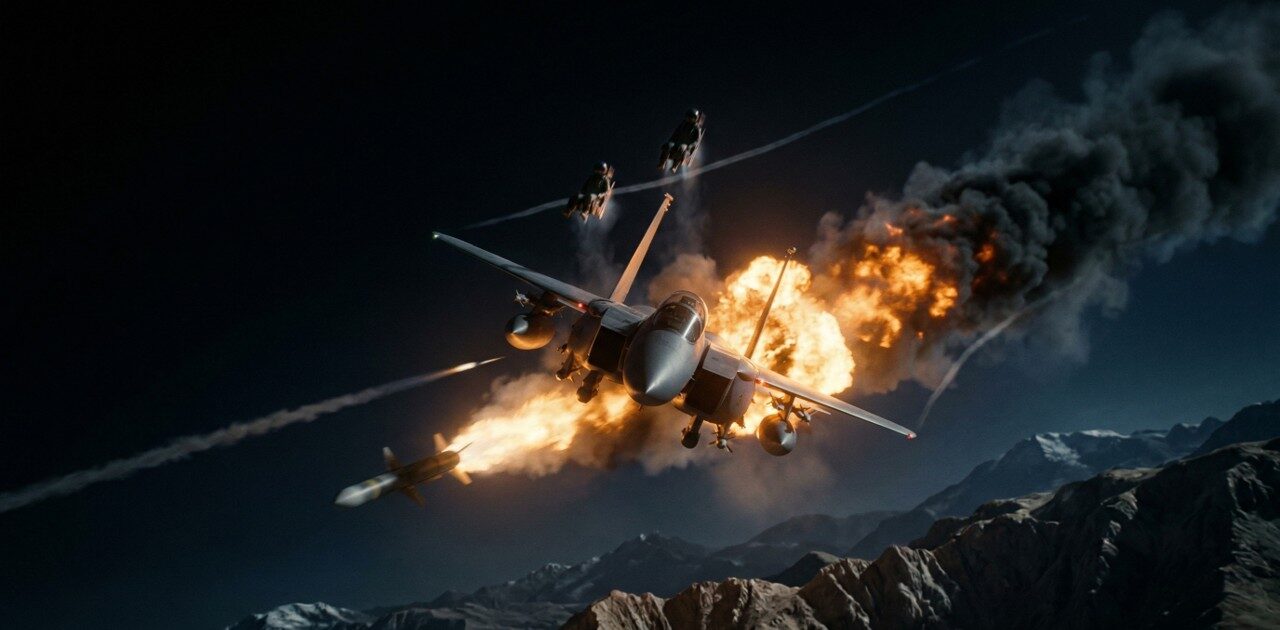
At 2:15 in the morning, two F-15E Strike Eagles crossed into Iranian airspace at low altitude. Their target was a deeply buried command bunker. To stay invisible, they used terrain-following radar, hugging the valleys, staying below Iran’s Baver 373 long-range missile network.
But here’s the problem. To actually drop the GBU-28 bunker buster, the lead jet had to pull up. Above the mountain ridge. Breaking the radar horizon. And in the gorge below, a highly mobile TOR surface-to-air missile system was waiting.
It got a lock. Two missiles fired. The pilot dumped flares and pulled hard G-turns. One missile was spoofed. The second detonated on proximity — close enough to cause catastrophic hydraulic failure. Both crew members ejected into pitch-black mountainous terrain.
The Sandy protocol was immediately activated.
Stage One — Survival
The pilot was recovered within hours. But the Weapons Systems Officer (WSO) wasn’t so lucky.
Wounded from the ejection, he landed deep in rugged terrain. And this is where survival training takes over completely. Despite his injuries, he hiked over 2 miles and scaled a 7,000-foot ridge line. He triggered his emergency beacon to let US forces track his position. But he couldn’t stay on the radio. If he transmitted too often, the IRGC’s signals intelligence teams — who were actively hunting his frequency — would pinpoint his exact coordinates.
So communication had to be sporadic. Calculated. Every transmission was a risk.
Stage Two — The CIA’s Deception Game
While the WSO stayed hidden, the CIA launched a massive disinformation campaign inside Iran.
They started leaking rumors that US forces had already located the WSO and were trying to smuggle him out on the ground. It worked perfectly. Iranian military resources were completely diverted — looking in the wrong place entirely — while the actual extraction was being planned. A phantom ground exfiltration that bought critical time.
Stage Three — The Tip of the Spear
It’s 2:00 AM. The skies over southern Isfahan are usually dead silent.
Not tonight.
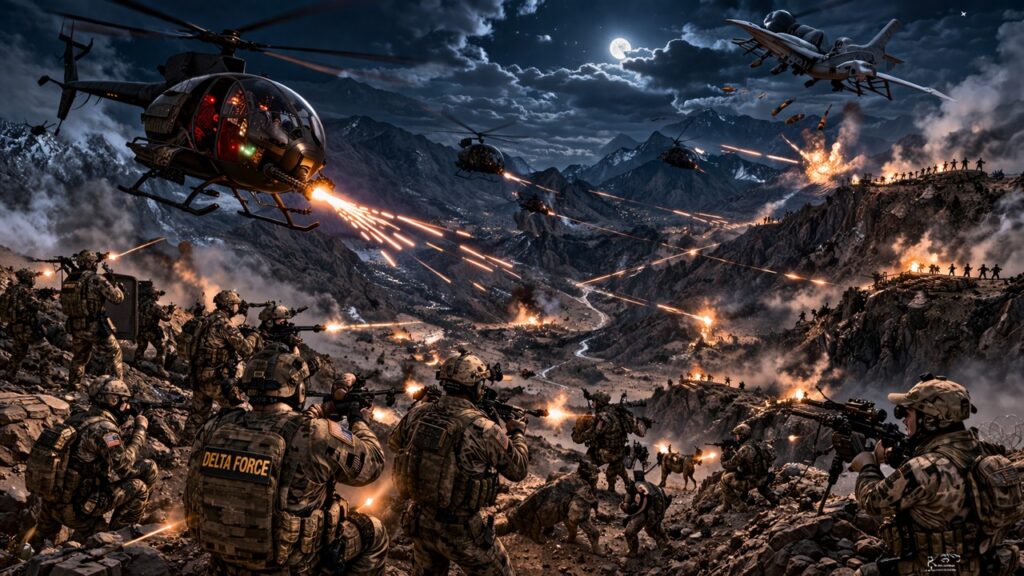
Delta Force and Navy SEAL Team 6 launched a full-scale airborne assault. MH-6 Little Bird helicopters — armed to the teeth with miniguns and missiles — designed for agility in tight mountain terrain. Alongside them, MH-60 Black Hawks built to insert and extract special forces fast. And miles above the mountains, an invisible electronic net — HC-130J Combat Kings and EA-18 Growlers — unleashing a storm of electronic warfare to blind Iranian early warning radars completely.
An MQ-9 Reaper drone kept an unblinking eye on the wounded WSO the entire time.
Stage Four — A US Base, Inside Iran
This is the part that sounds almost unbelievable.
The US literally set up a temporary forward operating base inside Iranian territory. An abandoned agricultural airstrip — just 200 feet wide and 3,900 feet long — located about 14 miles north of Shiraz in southern Isfahan province. They turned an empty Iranian field into a US staging ground. Mid-mission.
Stage Five — The Firefight
US special forces successfully navigated the jagged landscape below radar level, reached the WSO, and established a defensive perimeter. For a moment, it looked like it might actually work cleanly.
Then the horizon started moving.
IRGC ground forces, popular mobilization units, and local militias were converging on their exact location from all sides. What followed was an hours-long firefight in broad daylight. A 360-degree defensive perimeter, guns up, air cover overhead, suppressive fire going out in every direction.
The A-10 Thunderbolts rained hellfire down on the advancing Iranian units. Little Birds and Black Hawks pounded surrounding positions continuously. The sheer volume of close air support — it literally tipped the battle. It bought the ground teams the one thing they needed most. Seconds.
Under that umbrella of intense air cover, the special forces finally loaded the wounded WSO onto an extraction helicopter.
When Things Went Wrong — Again
Just when it seemed like they were in the clear, two transport aircraft at the makeshift landing strip near Shiraz City suffered critical failures. They couldn’t take off. The IRGC was speeding toward the airstrip in a massive convoy.
Commanders made the call. Three more aircraft were sent in. And the two disabled transports? US forces blew them up on the ground. Scorched earth. Left nothing but charred wreckage for the IRGC to find.
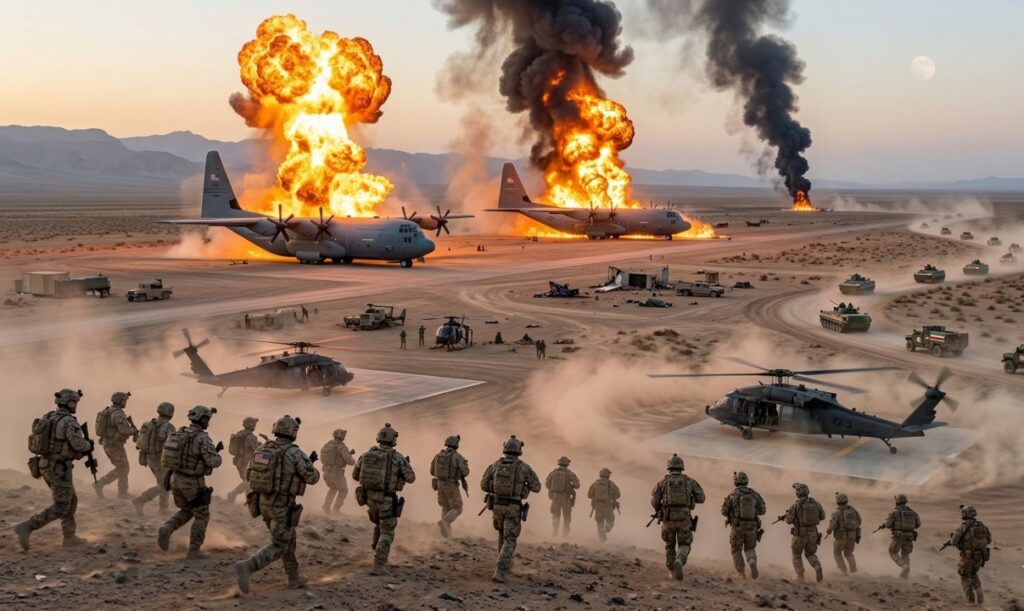
Wreckage of an MH-6 Little Bird helicopter was also spotted near the remains of an HC-130J Combat King — both deliberately destroyed by US airstrikes to prevent classified military data from falling into Iranian hands.
The A-10 Goes Down Too
During the rescue escort mission, an A-10 Thunderbolt executing a low-level strafing run with its 30mm Avenger cannon neutralized an Iranian convoy closing in on the downed crew. But the noise and tracers gave away its position.
Iran had recently introduced Chinese-made shoulder-fired infrared guided missiles — essentially reverse-engineered Russian MANPAD clones. One of those missiles shredded the A-10’s right turbofan engine.
But this is the A-10. The armor held. The pilot pointed the dying jet away from the mountains toward safer airspace before ejecting over the southern waters of the Persian Gulf, near the Strait of Hormuz.
The Combat Search and Rescue Package
At 3:15 in the morning, a dedicated CSAR package launched. An HC-130J Combat King acting as an airborne command center. Two HH-60D helicopters — callsigns Pedro 11 and Pedro 12 — flying under radar, refueling in midair to maximize loiter time.
Pedro 11 located the A-10 pilot’s infrared strobe. Pedro 12 circled above on overwatch. Then a hidden Soviet-era ZU-23 anti-aircraft gun opened up from a concealed position. An ambush. Heavy armor-piercing rounds tore through Pedro 12 as it orbited — severed transmission lines, injured crew, hard controlled crash.
The rescue mission just became a fight for survival.
Under heavy covering fire, the crew of the downed chopper sprinted to Pedro 11. Two F-35s — loitering high above in stealth overwatch — dropped precision munitions on the anti-aircraft position. Silenced.
Pedro 11, now overloaded and screaming at maximum power, barely cleared the tree line. They dove back into the valleys and raced for the Iraqi border. By 5:30 in the morning they crossed back into Iraqi airspace. Battered. Overloaded. Alive.
How Iran Actually Hit an F-35
There’s one more part of this story that changes how we think about air warfare.
An F-35 was also hit during one of its mission sorties. And to understand how, you need to know one key thing: there are two completely different types of missile threats — radar-guided and heat-seeking.
The F-35 was built to be nearly invisible to radar. Its geometry and radar-absorbing materials make its radar cross-section incredibly small — essentially invisible to traditional early warning systems. But it’s powered by a Pratt and Whitney F135 engine. One of the most powerful fighter engines in the world. And that engine produces a massive heat plume.
Infrared Search and Track systems don’t use radar at all. They’re passive sensors that scan the sky for heat anomalies. And because they emit no energy themselves, the F-35’s radar warning receivers wouldn’t alert the pilot the way a radar lock would.
Iran’s suspected weapon here is the 358 anti-aircraft missile — a hybrid between a loitering munition and a surface-to-air missile. It flies at subsonic speeds, can loiter in a figure-8 pattern, and uses optical and infrared sensors to detect targets. If guided by a ground-based IRST network, it could engage the F-35 entirely within the infrared spectrum — bypassing stealth capabilities completely.
The F-35 does have the Distributed Aperture System — six infrared cameras giving a full 360-degree view — which detected the incoming missile’s heat signature and alerted the pilot. High-G evasive maneuvers, flares deployed. The missile tracked the flares but detonated close enough for its proximity fuse to trigger. Shrapnel and shockwave damaged control surfaces without a direct hit. The F-35 executed an emergency landing.
This is what changes the equation. Fifth-generation fighters were supposed to operate with near-total impunity in contested airspace. This incident proves that infrared detection is a real and evolving counter to stealth technology.
The Bottom Line
The F-15E crew was still missing. That required a massive JSOC raid the following night.
But what this entire operation shows is simple. The US military doctrine of leaving no one behind isn’t just a principle. It’s an operational commitment they’re willing to pay almost any price to honor — including burning $100 million worth of aircraft on enemy soil just to make sure nothing classified gets left behind.
That’s the standard. And apparently, they intend to keep it.